
Pallavi Sherikar
Manager
The Climate Finance Action Compass helps align government, civil society, and the private sector on the full range of financial architecture reforms needed to maximize climate finance opportunities.
Learn More
The Baku-to-Belém Roadmap to 1.3 trillion marked an important step forward by bringing fragmented financial architecture reform priorities into a more coherent agenda. However, translating these priorities into action requires greater coordination, transparency, and a shared understanding of where progress is being made and where gaps remain.
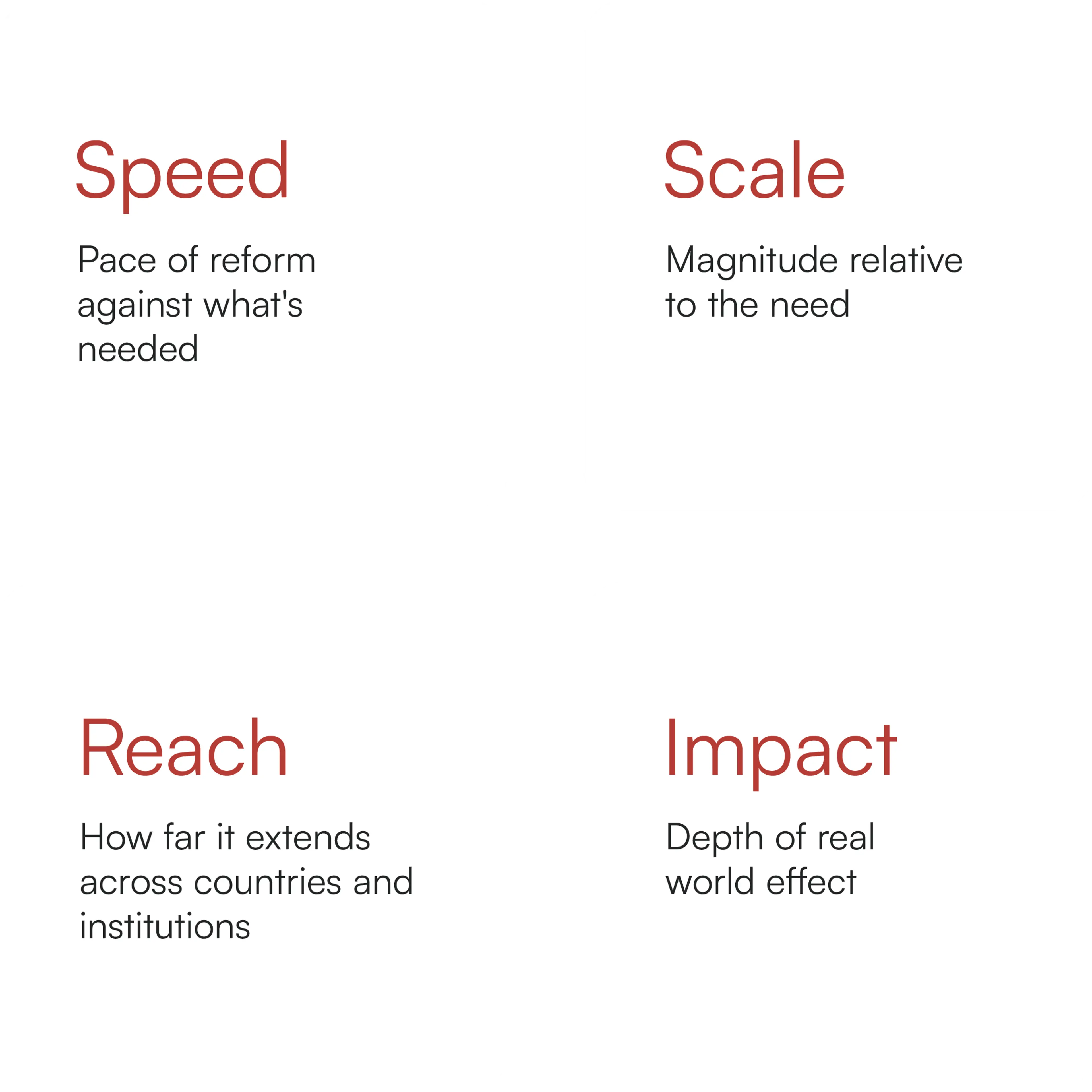
Building on IHLEG recommendations, the Compass takes an ecosystem-wide view of climate finance, tracking progress across three interconnected pillars: (1) country-led investment, (2) accelerating investment in key transitions, and (3) delivering on the capital stack. Each pillar is broken down into key action areas like Carbon Markets and Vertical Climate and Environmental Funds (VCEFs) which are assessed across four dimensions — scale, speed, reach, and impact — highlighting where action areas are advancing, where progress is lagging, and which actors and actions are needed to move forward.
By bringing fragmented efforts and evidence into a single view, the Compass aims to strengthen coordination, accountability, and collective action across the climate finance system, helping ensure that efforts across the international financial architecture translate into tangible outcomes for people and economies.
Action Areas are assessed across the four dimensions as well as across the 5Rs, which highlight ways to improve how climate finance is raised, managed, and delivered:
The Scale, Speed, Reach and Impact framework looks at progress through four lenses:
The 5Rs cut across to indicate how to enable investment and implementation in developing countries:
To answer these questions, the Compass assesses each area using both quantitative and qualitative evidence from the IHLEG. It looks at available data, including how much finance is flowing, how quickly it is growing, and where it is going. It also considers changes in policies, partnerships, and financing approaches that could drive future progress.
Each area receives a qualitative rating of Low, Moderate, or High, with intermediate ratings (Low-Moderate and Moderate-High) based on the available evidence and relevant goals. Where information is too limited to assess, the area is marked Insufficient Evidence. Together, these ratings give a clearer picture of achievements, gaps, and, most importantly, where further action is most needed.
Manager

Senior Manager

Program Associate
Senior Design Associate, Data Visualization

Senior Communications Associate